
#21: China's Urbanization Odyssey
Did you know that China's urban population skyrocketed from 26% in 1990 to an astonishing 64% in 2023?

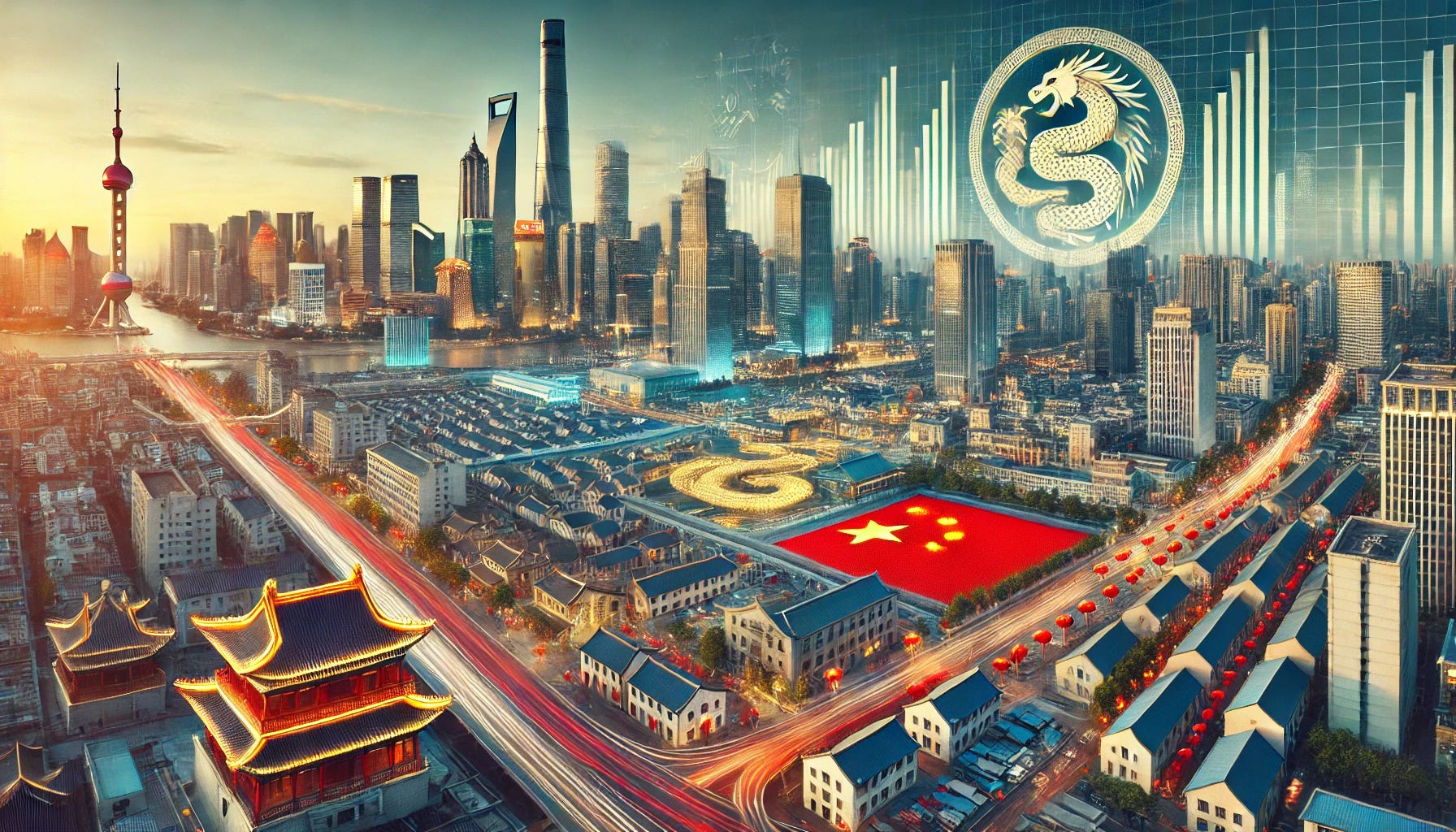
Did you know that China's urban population skyrocketed from 26% in 1990 to an astonishing 64% in 2023?
That's over 900 million people living in urban areas today, a figure that rivals the entire populations of the United States and Europe combined!
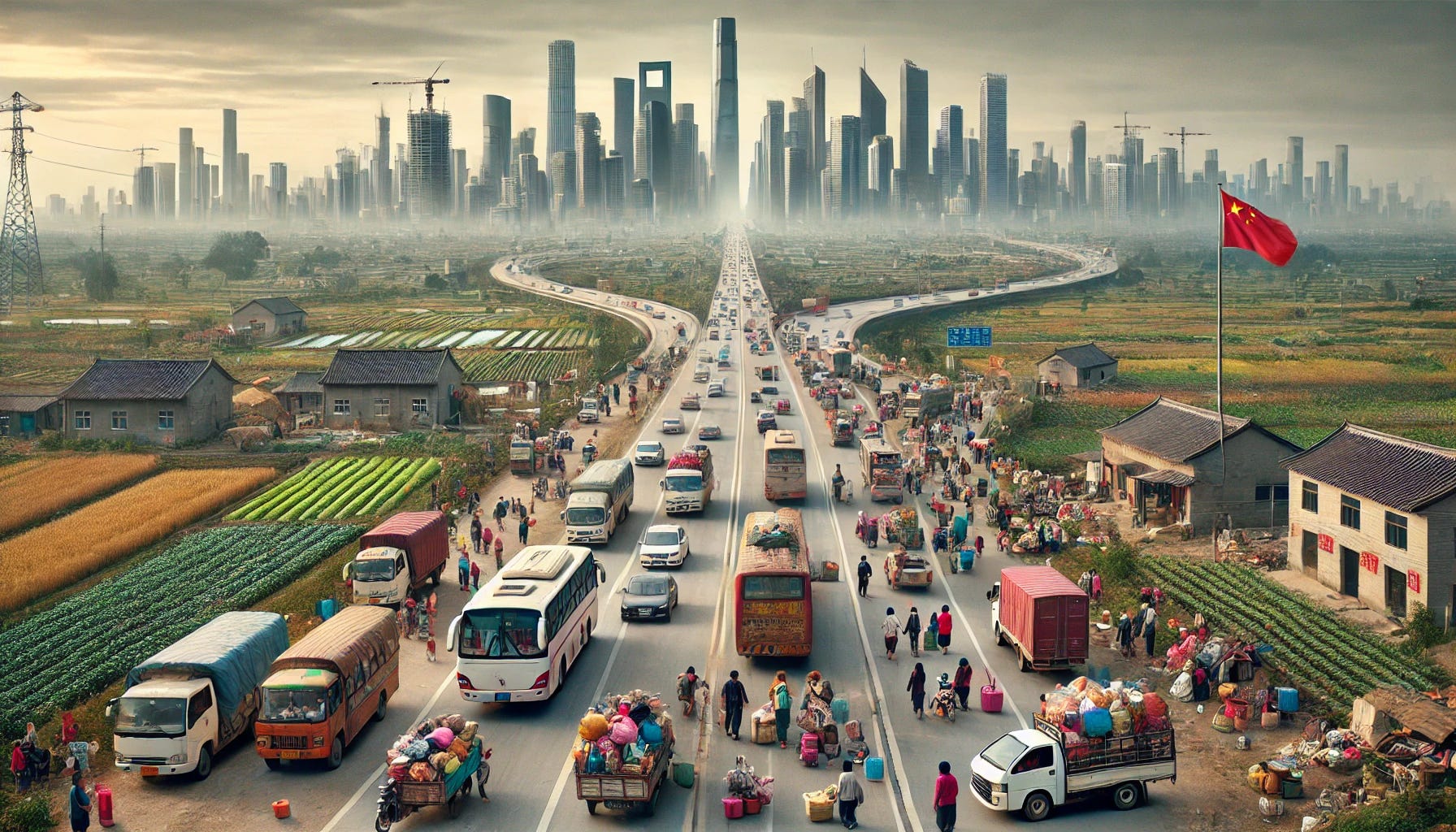
And it gets crazier when you think of it this way: Imagine a nation where a population equivalent of two USAs have moved from rural areas to cities in just four decades!
This is the awe-inspiring reality of China's urbanization, a phenomenon that has transformed the country's landscape and sent ripples across the globe.
In this edition of "Decoding The Dragon," we navigate through the concrete arteries of China's massive urbanization story, uncovering how this transformation has reshaped the global landscape of cities and economies.
The Seeds of Urbanization: A Historical Perspective
China's urbanization story is rooted in a complex interplay of historical, economic, and political factors.
In the decades following the founding of the People's Republic of China in 1949, urbanization was relatively slow.
However, the implementation of the "hukou" system, a household registration system that tied people to their place of origin, played a crucial role in limiting rural-to-urban migration.
The turning point came in the late 1970s with Deng Xiaoping's open-door policy, which ushered in a new era of economic reforms and market liberalization. These reforms dismantled barriers to internal migration, allowing rural residents to seek better opportunities in cities.
This shift led to the birth of the "Special Economic Zones" like Shenzhen, which transformed from a small fishing village into a mega-city within a few decades.
The lure of higher wages improved living standards, and greater educational opportunities have since triggered a massive wave of rural-to-urban migration.
..
Numbers speak for themselves.
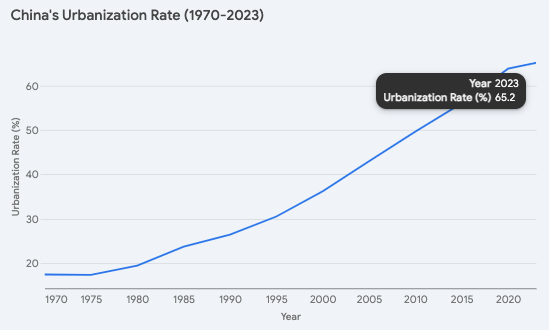
By 2000, approximately 36% of China’s population lived in urban areas.
And since then it has already risen to a crazy big 65%!
But, how did this happen?
The Rise of Megacities and Urban Clusters: A Modern Metropolis
As evident from the data, in the 1990s, China's urbanization had gained significant momentum.
Coastal cities like Shanghai, Shenzhen, and Guangzhou experienced explosive growth, fueled by foreign investment, export-oriented manufacturing, and the development of special economic zones.
These cities became magnets for migrant workers, entrepreneurs, and investors, transforming into bustling metropolises with modern infrastructure, thriving economies, and vibrant cultural scenes.
And then came the 21st century when China's urbanization evolved beyond individual cities. This was a pivotal era as China aggressively pursued urban growth to sustain its economic expansion.
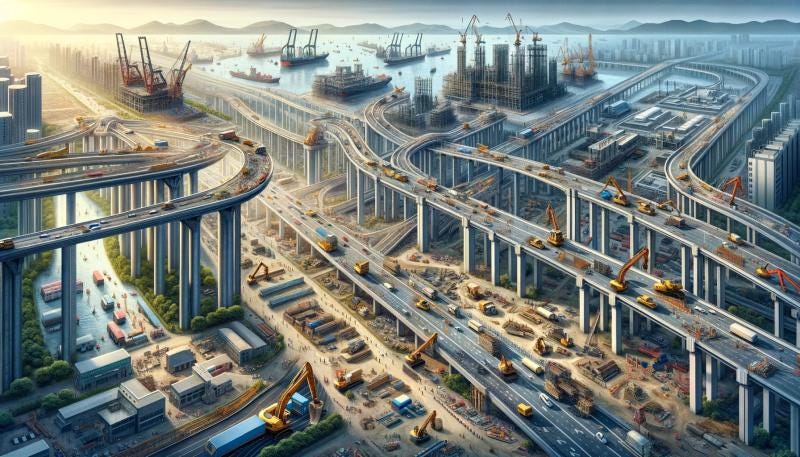
The government's focus shifted towards fostering regional integration and creating massive urban agglomerations. Towards this cause, China launched massive infrastructure projects, including the development of new cities, roads, metro rail networks and also the world’s largest high-speed rail network.
A catalyst in this journey was the 2008 Beijing Olympics, ahead of which China had pursued an unseen and unbelievable all-around infrastructure build-up exercise.
As a result, this drove urban proportion to leap from 36% in 2000 to over 50% by 2010, reflecting a shift that took most countries several decades to achieve.
Today’s Urban Giants: The 2023 Landscape
As of 2023, China boasts more than 223 cities with over one million residents each.
While the Chinese government has been the primary architect of this urbanization, other stakeholders have also played crucial roles in shaping the urban landscape.
Infamous real estate developers like Evergrande and Country Garden (which are now battling bankruptcy) have constructed vast housing complexes and commercial properties, catering to the growing demand for urban living.
And, construction companies like CSCEC and CRCC have built the infrastructure that underpins urban expansion, including roads, bridges, railways, airports, and ports.
Also, the local governments have been responsible for implementing central government policies at the ground level, often competing with each other to attract investment and spur economic growth.
Their decisions and actions have significantly impacted the pace and direction of urbanization in their respective regions.
It’s because of a collective outcome, that major urban centres like Shanghai and Beijing have become global cities, influencing finance, culture, and technology.
However, this rapid expansion has not been without its challenges, including housing affordability issues and the environmental impacts of rapid urbanization.
Global Ramifications: China's Urban Transformation and Its Impact on the World
China’s urbanization is not just a demographic shift but a significant economic force.
It has created vast markets for consumer goods and services, driven demand in the construction sector, and significantly increased the country’s energy consumption, providing opportunities for businesses worldwide.
These urban centres have become hotbeds for innovation and economic activity, contributing to China maintaining its position as the world's second-largest economy.
But, it has also come at a price to the world. The country's rapid urban growth has fueled demand for commodities like iron ore, copper, and oil, driving up global prices.
It has also led to increased energy consumption and carbon emissions, contributing to climate change.
..
India and the US: Contrasting Paths of Urban Development
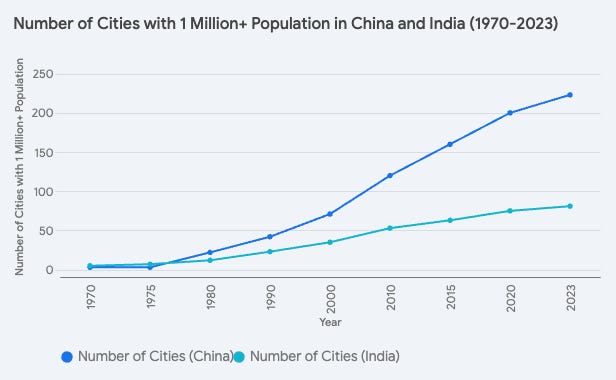
India's urbanization rate is lower than China's at around 35%, with a significant portion of the population still residing in rural areas. It is facing different sets of challenges such as infrastructural deficits and regulatory hurdles.
However, India's cities are growing rapidly, and the country is projected to add more urban dwellers than any other nation in the coming decades.
Meanwhile, if you compare it to the US, it is already a highly urbanized country, with over 80% of its population living in cities.
However, its urban landscape is characterized by suburban sprawl and car-centric development, in contrast to the more compact and transit-oriented cities found in China.
Thus, while both India and the US are urbanizing, with the US being ahead of China, their experiences differ significantly from China’s.
Looking Ahead: The Future of China's Urbanization
As China's urbanization continues, the country faces a number of challenges, including environmental degradation, income inequality, and the provision of adequate housing and services for its growing urban population.
Key challenges ahead include managing the rural-urban divide, ensuring sustainable development amid environmental concerns, and addressing the socio-economic disparities that rapid urbanization often brings.
Recent policy shifts reflect this, with the focus shifting from an unbridled expansion to a sustainable urban expansion, promoting green spaces, and improving public transportation to reduce carbon footprints.
And, all of this is being done with a special focus on keeping housing prices in check, for which the Government is actively trying to incentivise people to migrate to cities which are not over-populated like Shanghai or Beijing.
Also, beyond this, the future of China's urbanization is also likely to be shaped by technological advancements.
Smart city initiatives, driven by big data, artificial intelligence, and the Internet of Things, are transforming the way cities are planned, managed, and lived in.
These technologies have the potential to address urban challenges and create more livable, efficient, and sustainable cities.
Conclusion: A Continuous Transformation
As China's cities continue to expand and evolve, they serve as both a blueprint and a cautionary tale for rapid urbanization.
The lessons learned from China's urban development are shaping global policies and influencing how nations around the world manage their urban transitions.
Stay tuned for the next "Decoding The Dragon" issue, where I will explore another fascinating element of China's transformative journey.
Very informative series on china , but I would recommend to make such series relating to opportunity in India, and development in India , it would be more great.